comment 1

The Mad Ones: The Murmur House

“The only people for me are the mad ones, the ones who are mad to live, mad to talk, mad to be saved, desirous of everything at the same time, the ones who never yawn or say a commonplace thing, but burn, burn, burn like fabulous yellow roman candles exploding like spiders across the stars and in the middle you see the blue centerlight pop and everybody goes ‘Awww’!”

Jack Kerouac, On The Road

There are many kinds of madness, but our favorite is the kind where it drives someone to purse their creative passion and embrace others to join them in being mad together. The Mad Ones is our new periodic column, in which we interview people who inspire us through their madness.

We are beyond excited to feature an interview with The Murmur House, a literary community for young Indonesian writers and illustrators. We first found The Murmur House on Twitter, and quickly pre-ordered the inaugural edition of Murmur, its literary journal. I still remember the surge of warmth I felt when the journal came, with its origami cat, literary quote, and brilliant collection of prose, poems, and essays. Here is what Syarafina Vidyadhana (Avi) and Rain Chudori (Rain), co-founders of The Murmur House, have to say about their budding literary community.
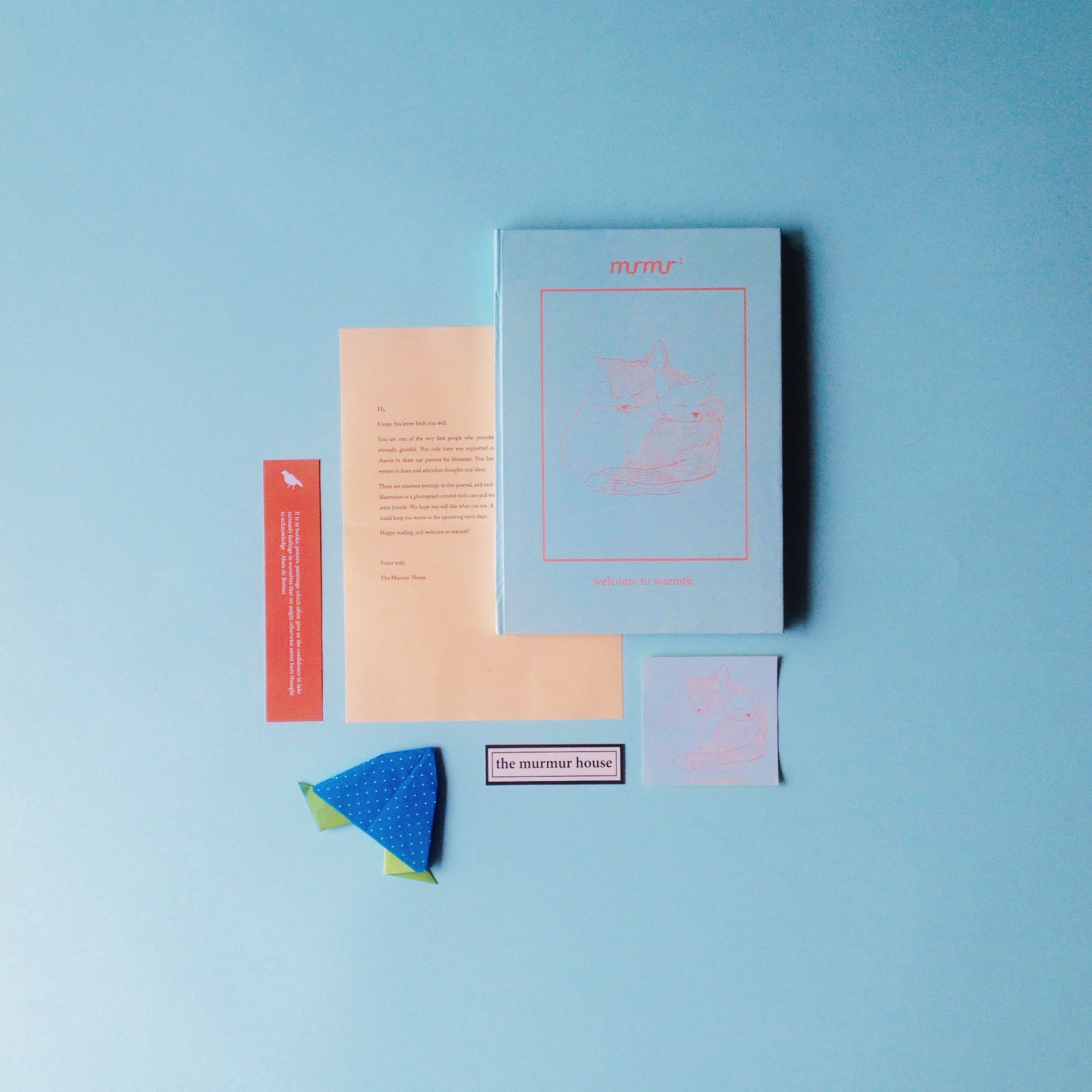
Murmur - Welcome to Warmth. Photo by Findhika Putra P. Hirawan of Morrie and Oslo

Murmur – Welcome to Warmth. Photo by Findhika Putra P. Hirawan of Morrie and Oslo

What is the idea behind The Murmur House? Why did you start it?

Rain: The idea first started when Avi and I were in a coffee shop by a lake. We were rambling about love and literature, I was really bothering Avi who was supposed to do her essay on existentialism in Le Petit Prince, if I’m not mistaken. As we continued talking, the topic switched to how solitary writing has been for writers, especially young ones. Today’s technology and the Internet in a way detach us not only from our roots but also from each other. So we came to the idea that there should be a platform for young, Indonesian writers to grow and share their works.

Avi: It’s a Christmas’ eve in 2013. I remember the coffee shop by the lake, the dreadful final paper, and the particular boys and books we talked about—but no, Rain wasn’t in any way bothering me. It was rather refreshing, conversing with her, for she was the first person before many that I met, who shared the same concerns on our local literary scene. Anyway, the name of the house was derived from Murmuration (n.), a natural phenomenon in which flocks of starling birds move together from one place to another during their migration. Their movements are very synchronized to the point that when one bird changes its movement, the other birds quickly adapt to it. They are also very sensible and caring towards each other.  We find this phenomenon to be extraordinarily beautiful. Thus, it has been our very philosophy in nurturing our house.

Who are the people behind the Murmur House?

Rain: Avi and I are the co-founders of The Murmur House. We have several departments in our house: editorial, events, shipping, design, merchandising, social media, and marketing. Each department consists of 2 to 3 members. I’m a writer, as are some of the other members. Several are literature students, though there are also those who work in other fields. Most importantly, we’re readers.

Avi: Also there’s Agustina Pringganti, editorial chief for our debut journal, and Dwiputri Pertiwi, the current editorial chief. We also have Shofwatul Widad, Meisya Citraswara and Ratnayu C. Kirana who have been there with us since the beginning, Alyssa Syamina, our translator, and many more.

Avi and Rain, co-founders of The Murmur House, during its first Murmuration event

Avi and Rain, co-founders of The Murmur House, during its first Murmuration event

Why do you choose English as the medium for your journal, Murmur? Did you find any criticism for choosing English instead of Bahasa Indonesia?

Rain: Initially, we chose English as our medium because we felt wanted a platform for Indonesians who writes in English. For our second issue and thereafter, we are planning to publish our journal in both English and Indonesian.

Avi: Our purpose is to break the language barrier and deliver our stories to a global audience, and to reach out to young Indonesian writers who are more comfortable writing in English. We believe there haven’t been many similar platforms in our local literary scene. However, that decision makes our journal enjoyable only to a specific kind of readers—those who are familiar with English. Based on this decision alone we received some criticisms, basically on how our journal seems somewhat “elitist”. Although I don’t agree with them, I think it’s quite understandable.

Still related to that, there’s been a debate on whether or not works written in English by Indonesian authors can be claimed as “Indonesian literature”. This is saddening, I believe language choice shouldn’t be a problem; Indonesian authors—and any authors anywhere—should be free to choose whichever language fits them best and not discriminated for it.

How do you balance the tension between curating quality pieces for Murmur and fostering an open, supportive environment for young writers?

Rain: our editor in chiefs, Agustina Pringganti and Dwiputri Pertiwi, have created a method of evaluating the pieces which the rest of the editorial team follows. We select pieces that are not only well written, but also honest and resonant to the qualities our house hopes to achieve.

Avi: To be honest, it hasn’t been easy. Our community is trying to reach out as many young Indonesian writers as possible. The aim is to be a house for writers to help each other grow, to share thoughts and experience, through our gatherings and other programs. Meanwhile, curating process is necessary because we have a responsibility to our readers and ourselves as editors to sustain the quality of our journal. The challenge is in explaining that the community and the journal are two separate things that require different approaches.

Murmur journal's editor in chief, Tina Pringganti, reading a piece in Murmuration

Murmur journal’s editor in chief, Tina Pringganti, reading a piece in Murmuration

Other than your Murmur journal, you also organize offline gatherings called Murmuration where writers are invited to read aloud. In the age of blogs, audio books, and social media, why do you think read aloud meet ups are important?

Rain: I think social media plays an important part in building our house. Without it, I wouldn’t have known Avi, or most of the members, writers, illustrators we have worked with. More importantly though, it’s important to cultivate the house through frequent gatherings. It’s warm, intimate, and the highlight of being in a community.

Avi: Offline gatherings are essential for growth—and they’re much fun, too! On our first Murmuration we were surprised because there were a lot of people who read aloud impromptu! I think many find reading aloud therapeutic. I personally like it because I get to meet real human beings and converse with them, and it definitely has more perks compared to exchanging 140 characters (or more) with an avatar (or profile picture).

Who do you think are the young Indonesian writers to watch? Can you share some of your favorite stories or books written by young Indonesians

Rain: Khairani Barokka is one of my favourite Indonesian writers. She is one of a few Indonesians who write in English. I find her writings raw and resonant, I was honored to have two of her poems in our journal. I think that Talissa Febra, one of our new editors, is a wonderful writer and I hope to read more of her work soon. Other writers I’m fond of are Arman Dhani, Aan Mansyur, and Agung Setiawan.

Avi: Yes, Okka (Khairani Barokka -ed.) is indeed special. She’s a strong independent woman with a great sense of humor, and she writes the most unique poems, too! And there’s Dwiputri Pertiwi, a young talented essayist and poet, who recently launched her collection of poetry ‘Hiatus’. Next on the list there’s Sabda Armandio Alif, he’s going to publish his first ever novel sometime soon and from the look of it, I think it’s gonna be great!
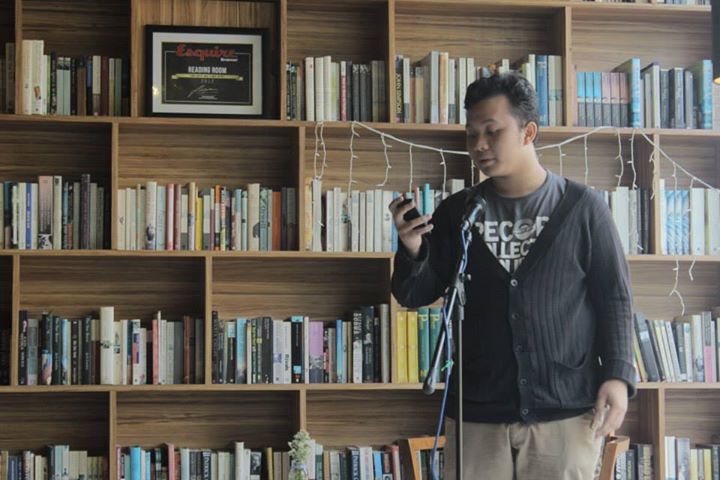
Raka Ibrahim reading aloud in Murmuration

Raka Ibrahim of Disorder zine reading aloud in Murmuration

What can we expect from The Murmur House in 2015? 

Rain: We’re blooming. We’re currently working on our second issue, “Love and Other Drugs” and we will launch it in our Murmuration event on February. On March we will have an exhibition in POST, Santa. We are also working on a workshop road trip to several cities. And on January 29th we will participate in the launching of idwriters.com, where I will also do a reading.

Avi: All that and a running website, yay!

How can people get in touch with you?

Avi:  www.facebook.com/themurmurhouse I Twitter: @themurmurhouse I Instagram: @themurmurhouse I E-mail: themurmurhouse@gmail.com.
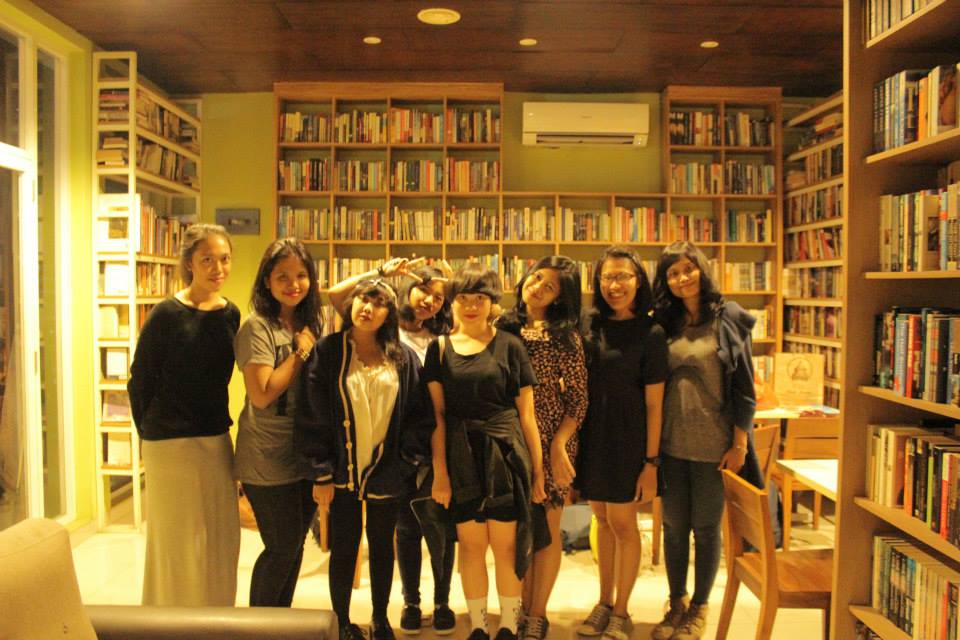
The Murmur House Team

The Murmur House Team

*The photos are courtesy of The Murmur House as well as Morrie and Oslo.

comments 20

To Take a Walk

“We need your help to start our second book,” I said when the microphone arrived in my hands. “Twosocks and I only know that we want to write about Jakarta, but we don’t know where to begin or what would be the most interesting angle. We’d love it if you could give us some ideas.”

My heart soared when I saw the many arms that shot up after I finished my plea. We were at the Q&A session in Goodreads Indonesia Festival’s workshop in December last year, where Twosocks and I talked about travel stories and Teguh Sudarisman, one of Indonesia’s leading travel writer and photographer, shared insights on how to best capture moments in one’s travels. The moderator asked us to give a question to the audience and I thought that asking the 80 or so people in the room to help us with our problem would be more interesting than quizzing them about our presentation on the types of travel writing or how to write a strong opening for your stories. And, to be perfectly honest, we do need help. Twosocks and I have known that we want to write about Jakarta for a year, but we never inched closer to actually deciding what about Jakarta. It is much harder to write about your own city rather than someone else’s.

Twosocks chose several among the waving arms, while I had my pen and notebook ready. The ideas were brilliant – exploring public transportation in Jakarta, seeing Jakarta from the eyes of children, and finding alternative hang out spots in this mall-infested metropolitan. One idea, though, resonated the most with the two of us.

The Dusty Sneakers I To Take a Walk

“Jakarta is a city that moves very fast. Partly because it’s a metropolitan, but also because people often see the city behind the windows of cars or public transportation. I wonder what it would be like if you slow down and travel around Jakarta by walking,” said a curly haired lady whose dress reminds me of spring*.

I could feel beads of perspiration forming on my back the moment she said that. Who wouldn’t be sweating if they walk in a city where the average temperature is 32 degrees Celcius? As an asthmatic, walking in Jakarta has also been a live game of Minesweeper for me. I always need to watch out for cigarette smoke and pollutants, for I will have to reach for my inhaler the moment I breathe them in. I also remembered the catcalls and racist comments that I would encounter from time to time in the 20 minutes it take me to walk home from work. Walking in Jakarta is not an easy task.

And yet, my fondest memories of Jakarta are when I was walking through the city. When Twosocks and I walked all the way from Bunderan HI to Pasar Baru eleven years ago, just because we didn’t want our conversation to end. When I was sitting with a friend in Taman Suropati after walking around Kota Tua and Menteng under the scorching sun, and he told me that it was the first time he found a friendly side to Jakarta. When I spent my 27th birthday walking around graveyards and museums in Jakarta and finally felt at home again in this city, after going through a hard time of readjusting upon my return from Den Haag.

Those moments, the good and the bad, are of my side of Jakarta, though. How would it feel to explore other versions of Jakarta on foot? How different would it be if we were to explore by ourselves, with friends who are strangers to the area, and with strangers who are locals to the places we were to go to? Would that change how we feel about Jakarta, the city where we’ve spent most of our lives?

So yes, we are intrigued. We will be walking all around Jakarta next year, regardless of whether our second book will turn out to be one about our how we experienced the city on foot. We also need to ask for another help, this time from you, our readers. We’d love to hear your thoughts about where to go and who we should be walking with. Where are your favorite places in Jakarta? Which areas are you most curious about? Do you know anyone we should be walking with? Or better yet, would you like to walk with us?

Processed with VSCOcam with hb1 preset

Jakarta, January 2015

Gypsytoes

*The curly haired lady whose dress reminds me of spring is Indri Yuwono, our new friend who loves traveling, reading, and writing as much as we do. Thank you for the inspiration, Indri.

comments 10

In Between Adieu and Hello

The last day of 2014 began slowly, with homemade cold brew latte in handmade ceramic mugs sipped while watching the grey clouds float, and then all at once, with a song and a dance.

Twosocks told me that he has found it, the song that will always remind him of 2014. I looked at him suspiciously – after all, this is the guy who once made me sit through him singing Roxette and Billy Idol songs during his three-hour karaoke birthday party. Then the first few notes played and my suspicion was replaced with gleeful recognition. Without saying a word, we stood up and danced.

It was the most awkward dance possible. Twosocks, who would jokingly said sometimes that dancing is his life, moved his shoulders and hips off beat and compensated by keeping his eyes closed. I am usually the better dancer between the two of us, but I was limping in my pajamas. My toes were a nasty shade of purple after I tripped on myself – yes, I tripped on myself, in my own hotel room, so help me God – a few days ago during our trip to Jogja. But the song was Garota, and it would be wrong not to dance to Garota.

Processed with VSCOcam with g3 preset

Erlend Oye, my musical hero, released Garota around the time when Twosocks and I found that our dreams were coming true. There was the dream we both always had since we were children – to publish a book – and the dream we didn’t know we had until we met our friend Steven in Pasar Santa – to start a space for books, gatherings, and all things creative in Jakarta. Both dreams came together in September, when we launched our first book, The Dusty Sneakers: Kisah Kawan di Ujung Sana, at POST, the space we co-founded with Steven. Twosocks once said that we had two babies in 2014, the book and POST, and he could not choose which one he loved better. Neither could I, although I found it strange that I loved the baby I didn’t know I wanted as much as I loved the baby I wanted all my life.

We twirled as Erlend sang, “Choose the life you want to live, give the love you want to give. Take the moment when it comes, let it lead you, let it run.” A little over a year ago, during a trip to Sekotong, we realized that we need more creativity in our lives; that as much as we love our day jobs, they are not enough to make the life we want to live. With salt in our hair, we promised to write more, to get to know more people, and to explore more of Jakarta. We’ve kept that promise.

2014 was a year of writing. Other than the book, we collaborated with our friends in Pamflet to come up with the Tur Kartini zine, a collection of our writing after following the footsteps of Kartini in Jepara and Rembang. We wrote more on this blog – Twosocks loved my stories about the bookshop in Bangalore, our writing process, and our first attempt in spoken word the most while I find his writings about the prison in Puerto Princesa, Kineruku in Bandung, and our first encounter with Pasar Santa to be my favorites. We reached out to people we only knew online and found ourselves with new, real life friends. We traded weekend adventures and long trips for weekends in Pasar Santa, but we got to know many different sides of Jakarta through the different communities collaborating with POST.

Processed with VSCOcam with hb1 preset

Twosocks and I know Garota’s video by heart, so we knew exactly when to raise our hands to the air when Erlend would or to nod when the audience in his concert nodded to the beat. We have plans for the new year, oh we certainly do. There is the seed of a new book waiting to be planted, the big road trip in the U.S. we’ve been planning for a year, the future of POST to think about, a new column in the blog where we’ll feature creative communities we admire, and stories, so many stories, waiting to be written. Tonight we will ring in the new year with our neighbors a few floors below, who we got to know through blogging, believe it or not. In a few minutes, Twosocks will have to snap out of his dancing and leave for the office while I’ll need to sit down and put some more ice on my sprained toes. Suddenly, 2015 seems like it is starting right now, instead of tomorrow.

In the mean time, though, Garota was still playing. Twosocks and I swayed from side to side, with me singing as off key as his moves were off beat, and I took everything in. The ceramic mugs on the coffee table, the books scattered all over our apartment, my own limping leg, the grey clouds outside, and Twosocks trying his best to remember the lyrics and sing along. I could wish for so many things to happen in 2015, but I could only think of right now, of moments like this. So I made a wish, and I wished for more moments like this.

Processed with VSCOcam with a5 preset

Gypsytoes

Happy new year, folks. May your 2015 be filled with fireworks.

comments 14

Pria Necis Dengan Singlet Kumal

Seekor anjing hitam berlari mendekati kami. Moncongnya tertunduk hingga sedikit di atas pasir pantai yang menguning. Totol-totol putih terlihat di tempat-tempat yang tidak menunjang estetika.  Anjing kampung biasa dengan leher telanjang. Saya waspada, menjaga kemungkinan ia datang untuk cari gara-gara. Pada jarak beberapa meter, si anjing melambat. Kini ia berjalan dengan ekor yang mengibas-ngibas. Gypsytoes dan saya menarik nafas lega. Si anjing tidak sedang cari gara-gara. Seperti kami, suasana hatinya pun sedang riang.

Pagi-pagi buta kami bangun dan menyetir ke selatan menuju Pantai Mengiat di Nusa Dua.  Kami tiba saat matahari baru saja terbit, saat sinar kuning memantul di air yang bergerak perlahan, saat sekelompok burung kecil yang tadinya mematuk-matuk di bibir pantai sontak beterbangan ketika ombak datang, saat yang terdengar hanya bunyi ombak dan cuit-cuit burung. Ini tentu suasana yang membuat hati tenteram. Tak terkecuali si anjing hitam. Tak terkecuali kami. Ini jenis suguhan yang bisa membuat seseorang tiba-tiba berpikir dirinya penyair. Semembosankan apapun ia.

Kami lanjut berjalan menyusuri garis pantai dengan si anjing yang mengekor di belakang. Terkadang kami omong-omong tentang suatu hal, terkadang diam-diam saja. Gypsytoes menyiulkan sesuatu. Siulan yang sember dan putus-putus. Ia meminta saya menebak lagu yang sedang disiulkannya. Mana kutahu, jawab saya. Itu “Moon River”, katanya.  Ia bersiul lagi dan berkeras tak mungkin saya tak mengenal nada itu. Bahwa siulannya sember dan putus-putus tampaknya bukan sesuatu yang ia perhitungkan. Saya katakan siulannya mulai bisa diterima sebagai nada “Moon River”, tapi itu lebih karena saya sudah tahu apa yang sedang coba ia perdengarkan.  Lalu saya menyiulkan “Love Story” dari Andy Williams dan memintanya menebak. Gypsytoes berang dan menuduh saya cuma cari gara-gara. Ia benci lagu itu. Lagu dari film dengan judul sama yang saat SMP dulu bikin saya menangis terharu, tapi olehnya dianggap picisan bukan kepalang.

Kami teringat perbincangan pagi buta tadi saat di mobil terdengar lagu-lagu natal, salah satunya Michael Buble yang menyanyi “Silent Night”. Ini lagu yang memberi suasana syahdu saat mobil berjalan di jalanan kosong di tol atas laut Bali yang megah itu. Saat itu di beberapa sisi terlihat barisan gunung dan langit yang memerah. Laut sedang tenang setenang-tenangnya. Kami berdiam-diam, hanyut bersama lagu dan suasana.

“Kau tahu adegan film apa yang pas untuk lagu ini?” saya memulai percakapan.

“Apa?”

“Ia lagu di bagian akhir film, mengiringi adegan seorang tokoh yang menenteng golok lalu membantai korbannya yang sedang tidur pulas. Tanpa ampun. Golok berayun. Darah muncrat. Crat! Tirai putih berubah merah. Semua ditampilkan dalam gerak lambat.”

“Di akhir lagu, yang disorot hanya tangan sang tokoh yang menenteng golok. Darah menetes pelan seirama dengan nada akhir lagu ini. Tes, tes. Film selesai. Layar gelap.”

“Ironis.”

Tol atas laut Bali

Anjing hitam dengan totol-totol putih di tempat yang tidak menunjang estetika itu masih mengekor. Burung-burung yang mematuk-matuk di pasir beterbangan saat kami lewat. Gypsytoes sesekali masuk ke laut hingga air membasahi lututnya. Sedang riang ia rupanya. Omong-omong tentang ironi, kami berbincang tentang betapa perjalanan pagi buta di atas tol atas laut itu juga memiliki ironinya. Betapa hal indah dan megah itu dibuat dengan memancangkan beton-beton ke laut, mengujamkan berton-ton kapur ke laut, merusak hutan mangrove dan segala ekosistemnya. Dan hal itu dilakukan dalam rangka mendatangkan lebih banyak pengunjung ke wilayah selatan Bali. Wilayah yang semakin tak kuasa  menampung lebih banyak wisatawan.

Bali selalu indah. Indah sekali bahkan. Namun, pada saat yang sama, selalu ada ironi yang menampar. Ia indah tapi sampahnya makin menggunung. Ia asri tapi air makin sulit di banyak daerah. Ia megah tapi budayanya makin megap-megap. Penduduknya konon ramah dan bersahaja, tapi di jalan-jalannya berjajar baliho ormas dengan wajah pria-pria sangar. Pembangunan semakin gencar tapi penduduk lokal semakin tergeser ke bangku penonton. Ia terus dipoles tapi meninggalkan ironi. Seperti pria necis dengan singlet kumal.

Saya ingat sebuah sore, dulu sekali, saat berjalan di salah satu pantai di Nusa Dua bersama ibu. Saat kami berjalan menikmati pantai, seorang satpam hotel mendekat. Ia meminta kami pergi karena garis pantai itu milik hotel. Ibu, jika kau mengenalnya, bukan perempuan yang mudah gusar. Tapi waktu itu, entah karena idealisme atau karena ia tak rela sore sempurna untuk anak kesayangannya rusak, ia mulai merepet. Ia bertanya apakah Pak satpam orang Bali. Saat satpam mengangguk, ia lanjut merepet dan menghujatnya karena mengusir sesama orang Bali dari tanahnya sendiri. Kami tidak sedang mau bikin kotor di sini, cuma mau lewat dan bersantai, tak lebih, begitu katanya. Ia masih lanjut merepet dengan mengatakan tindakan mengusir macam begini bisa bikin leluhur berang. “Berani kau dikutuk leluhur?” begitu ia mengancam.  Ibu-ibu yang sedang merepet memang sanggup menerbitkan ngeri.  Pak satpam gentar dan membiarkan kami lewat.

Di ujung garis pantai ada sebuah bukit karang bernama pulau Peninsula. Gypsytoes dan saya naik ke sana menuju sebuah tempat di ujung, tempat batu-batu karang berdiri tepat di bibir laut. Dari atas bukit terlihat garis pantai Nusa Dua seperti garis kuning yang berkelok-kelok. Di bawah, air laut menghantam karang hingga menimbulkan ombak pecah yang terkadang memuncrat hingga ke atas. Terkadang ada burung yang terbang rendah. Si anjing telah berlalu. Tadi ia bertemu anjing lain yang juga melonjak-lonjak girang. Kami duduk bersebelahan melihat laut dan garis pantai yang berkelok-kelok itu. Kepala Gypsytoes terkadang bersender di bahu saya. Seperti muda-mudi saja.

Pantai Mengiat Nusa Dua

Ini satu hal yang selalu saya sukai tentang Bali. Sebanyak apapun urusanmu, kau selalu bisa mencuri waktu untuk hal-hal indah begini. Di sini hal-hal indah ada di banyak tempat dan rata-rata dekat saja. Saat itu kami di Bali untuk perayaan Galungan. Itu adalah saat di mana hari penuh dengan persembahyangan, mengunjungi sanak saudara, bermain dengan keponakan, dan semacamnya. Menyenangkan, tentu, tapi penuh. Karenanya, setiap hari kami bangun pagi-pagi dan mencuri waktu untuk diri kami sendiri. Mengunjungi laut, berjalan di bibir pantai, melihat matahari terbenam, melihat burung-burung yang mematuk-matuk di pasir yang kemudian beterbangan saat kami lewat.  Menenangkan sekali. Walau begitu, perasaan campur aduk masih akan selalu ada karena hal-hal ironis tadi, perkara pria necis dengan singlet kumal tadi. Namun untuk sekarang, masih banyak sisi Bali yang indah. Indah sekali bahkan.

Entah sampai kapan.

Twosocks