Written by: Rivandra Royono, a fellow traveler, one funny dude
As a rule of thumb, Singapore is among the last places I’d visit. I’ve always felt that the city was, well, fake. Sometimes I thought perhaps that sentiment came partly from envy; that may well be true, but it’s also a fact that I just can’t feel the vibrant life in the city state—something that I always look for when I visit places. The thing is, two of my very good friends worked in Singapore and we’d been planning to get together for quite a while. And you can count on Anton and Adrian to inject some excitement to even one of the most boring places on earth.
So I boarded the cheapest budget airline I could get, with just one small backpack, to Singapore for the weekend. I was quite impressed when we boarded Tiger Air on time, but then discovered that we practically had to spend the entire night on board the aircraft. The plane was full, and I sat right behind a woman wearing a headscarf reciting holy verses from a pocket-size Koran that she held in front of her face. When we finally took off, she must have had read half way through the scripture, while half of my body had gone numb (somehow I can’t entirely dismiss the possibility that the two were connected).
I landed half an hour before midnight and was super excited when I saw my boys picking me up. The first thing Adrian asked when he saw me was, “So did you see the mbak-mbak berjilbab reading the Koran on the plane?”
I asked him how he’d known there was a mbak-mbak berjilbab reading the Koran on the plane, to which he responded, “There’s always a mbak-mbak berjilbab reading the Koran on any flight to and from Indonesia.” One of which, apparently, once sat right next to him and iron-gripped his arm while screaming bloody murder to his ear when the plane took off.
We drove away in Anton’s car from the airport through Singapore’s immaculate roads. Along the way, I noticed written signs on the road that read “strips ahead” and “humps ahead,” which at first I thought was the nanny state government’s idea of forcing their people to release their conceivably suppressed sexual tensions. But soon enough I discovered they were just signs to indicate pedestrian crossings and speed humps. I also learned that cars were exceptionally expensive in Singapore and oftentimes one needed to choose between having a good place to sleep or owning a car. Those who do own cars are either very rich, or prefer to have a facility to pick up women or men, at whose places they can have a sleepover anyway. Anton has a car, and Adrian has a relatively nice flat. And Anton is not that rich. So there you go.
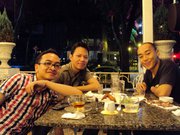
Coffee at Orchard
We ended up hanging out at a coffee shop on Orchard Rd., and just talked about absolutely everything, from love life, to travel, to work, to the good old days in college. At one point, Adrian told a story of the last time he went to Vietnam for business. He said the place was akin to Indonesia in the 1980s, where the people were obviously transitioning from a less developed to a promising, developing country. Many times, he had some difficulties communicating with the locals, most of whom spoke very little English. He even faced difficulties talking with the front desk of well established hotels, one of which led to the following phone conversation:
“Hello, Sah. Dis is frondesk. May I help you?”
“Hi. Yes. Can you send a set of iron and ironing board to my room, please?”
“A’m sollee. You wanna what, Sah?”
“An iron and an ironing board.”
“You wanna boy, Sah?”
“What? No! Ironing board. Board!”
“OK Sah. We send you boy. Thank you.”
After a few minutes, Adrian heard a knock on his door. When he opened it, he saw a very young Vietnamese man standing and smiling at him. Adrian went back to the room, picked up his shirts, handed them to the young man, and said, “Can you iron these for me?” The guy gave Adrian a puzzled look, slowly took the shirts, and said, “Um…that will be 10,000 dong.” Adrian nodded happily and saw the young man walk away with his shirts, probably adding one more kind of fetish to his mental note.
We finally left the coffee shop when we realized it was nearly 4 o’clock in the morning. I spent the night—or rather, morning—at Adrian’s three-bedroom flat, which wasn’t big, but was very nice and well-kept. We planned to sleep through the morning until noon, but ended up waking up quite early (10 a.m.) because it was already very bright inside the flat. Adrian had a gym session that Saturday so he asked me to go with him. Although the idea of exercising in Singapore while being sleep deprived wasn’t exactly my idea of spending the weekend, I thought I could use a re-introduction to the subway train system. And Adrian could get me to the gym for free, so why not.
Singapore’s subway system is one of the only few features of the city state that I really wish I could bring back home. It’s clean, reliable, obviously very well-planned, and even a half-brain-dead monkey can understand how to get around; which means at least 50 percent of our parliament members would have no trouble getting on the right train. It was also fascinating to see all the public service ads on “terrorism awareness” running on every screen in the subway stations. The ads asked all passengers to be in constant vigilant and report “suspicious individuals,” which was characterized as either looking nervous or angry, very quiet, fidgety, and reluctant to make eye contact with anyone. I imagined that would include people who were picking up their dates, facing exams, just lost their jobs, facing a lawsuit, just broke up, late for an appointment, stressed out with work, or trying to hold their bladders. When I got on the train, I realized I should report every single person on the car I was in, except one, which was a baby sleeping in a stroller. But I don’t even take heed of public service ads back home (like the big billboard in Depok that encourages people to use their right hands when they eat), and I was definitely not going to start in Singapore.
After the gym and lunch, we returned to Adrian’s flat and waited for Anton who’d pick me up and bring me to a typical Singaporean Malay wedding. While driving to the venue, Anton explained that the three major ethnic groups in Singapore each had its own typical wedding style. Many Malays opt to have wedding receptions in a semi-open space at the apartment complex they live in. The typical Chinese would have a banquet dinner at a hotel or building. Indian weddings tend to be elaborate and grand. The wedding that we were going to was of a Malay couple. Anton was a very close friend and compatriot of the bride’s father, being co-engineers on an oil rig a few years back, where they had to face major technical problems, Mother Nature’s wrath, and mutinous subordinates on a daily basis.
We arrived at the venue, an apartment complex, in the afternoon. The reception was held in a semi-open space, 8 by 5 meters, with two walls at the front and the back. Round tables were evenly placed, each having about ten chairs. A long table was set at the side to put the food. There weren’t a lot of people around, so we thought we had come a bit late. The parents of the bride greeted us with warm welcome and automatically directed us to the food table and, with an unmistakable gesture, effectively ordered us to eat. On the table, we saw briani rice, lamb satay, peanut sauce swimming in gravy, lamb stew swimming in gravy, diced beef swimming in gravy, fish covered in chili and gravy, fried shrimps covered in gravy, and chicken stew swimming in gravy. Oh and a small bowl of gravy. While one teaspoon of any of the dishes could potentially clog every major artery in a human body, they were all really, really tasty.
While we were eating, the father of the bride came and sat at our table and started chatting with us. He and Anton took turn telling me war stories on the oil rig, which I responded with polite nods and a smile, even if I understood only one out of every ten words that came out of their mouths. After a while, Anton asked him where the bride and groom were. The man looked at him and said, as a matter of fact, “Oh the wedding was called off. They broke up a few weeks ago.”
We looked at him and finally managed to mutter, “Oh. OK.” Apparently the former happy couple to-be decided to call off the wedding after all the invitations were sent out. And the caterer was a member of the family, who’d prepared everything for the wedding. So the father of the bride decided to continue with the pseudo-wedding and just have family and friends get together and enjoy some good food.
We later drove from the wedding to Dempsey Hill, where they turned an army barrack into a dining experience. There we met Kaisa, Adrian’s boss, who showed us some original features of the barrack that they kept well preserved. Afterwards we took a night excursion to a couple of bars, intoxicating ourselves with flammable liquids. We continued drinking and chatting until 2 o’clock in the morning, at which point I felt I could drop on the bar’s floor and doze off. Kaisa kindly offered us to go back to her apartment in Sentosa and open a bottle of champagne, but Adrian and I decided to decline. Anton took us back to Adrian’s flat and we called it for the night.
The next morning, Adrian cooked me some breakfast and we got to relax a little bit. It dawned to me that morning that throughout the weekend, on several different occasions, my host had made some colorful comments on every single race, ethnicity, and/or nationality that roams Singapore, including the Chinese (money worshipping gambling addicts); Malays and Indonesians (they’re like sperms—there are millions of them but only one works); Indians (why are they so hairy? Like, all over!); Filipinos (my God, they’re so clingy to each other. I’d walk down the road and one would approach me and ask to my face, “Filipino?”); and Caucasians (looters of nations. And why don’t they shower?). It seems that Adrian’s angst is not directed to a specific race, but rather the entire human population. So I guess by definition, he’s not a racist, but a humanist.
Afterwards, Kaisa and Adrian went to the gym—again. They got me to tag along and Kaisa told me she’d show some cool features of Singaporean streets. At one point, she showed me an original Dali sculpture, made as homage to Newton. And when a genius made homage to another genius, I definitely had to see it. The sculpture was distinctively Dali, surrealist and abstract. The figure’s hand held a hanging ball, which represented the legendary apple that inspired Newton to formulate his laws of gravity and mechanics. The torso was hollowed and the head almost seemed cracked open, which, according to the plaque that describes the art, symbolized “open-heartedness” and “open-mindedness,” two qualities Dali believed were required of Newton to unravel the mysteries of the universe. I couldn’t help but imagine that if the sculpture had been put up in one Indonesia’s public places, the FPI would’ve demanded it to be taken down or even destroyed it themselves, because: (a) Newton was a Christian; (b) the sculpture is severely disfigured, which would be an abomination to God the Creator; and (c) its penis is showing.
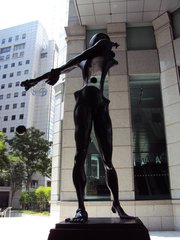
Dali's homage to Newton
At the end of the day, my weekend in Singapore had not changed my sentiment about the city state. It’s still not my cup of tea and it’s still some of the last places I’d go and visit. But I also learned from the trip that sometimes, when you travel, the company matters more than the place you visit. In bars and coffee shops, between espresso shots and whiskey-drenched chocolate ice cream, Anton and Adrian made me laugh, listened to my stories, showed support, and helped me cope with whatever life is throwing at my face. They tried to look out for me and gave me advice. Yet I know that even if I don’t take their advice and things blow up in my face again, I can always spend another weekend in Singapore and they’ll be there for me again. Although Adrian did say he’d at least give me the look if I did anything he considered stupid. Fair enough.
On board the plane taking me back home, I went straight to my seat, put my bag under the seat in front of me, and sat down. As I was waiting for the plane to taxi, I heard a familiar murmur somewhere behind me. I stood up, turned around, and sure enough saw a young lady in a headscarf reading from a pocket-size Koran that she held right in front of her. Holding back laughter, I sat back down and buckled up. I missed my friends already.




 The Dusty Sneakers